For over two decades, the standard search engine for products relied almost entirely on lexical inverted indexes, such as Apache Lucene, Elasticsearch, and BM25 string matching. While lexical matching works adequately for exact SKU identifiers or exact brand names, it fundamentally fails when shoppers search with natural language, typos, synonyms, or conceptual requirements. In modern AI ecommerce, understanding buyer intent is critical. This architectural guide explores why pure keyword engines struggle, why pure vector search introduces unintended edge cases, and why a hybrid search engine for products combining dense vector embeddings with lexical precision and merchant AI merchandising rules represents the definitive standard in 2026.
1. The Anatomy of an E-Commerce Query: Why Retail Search Differs from Web Search
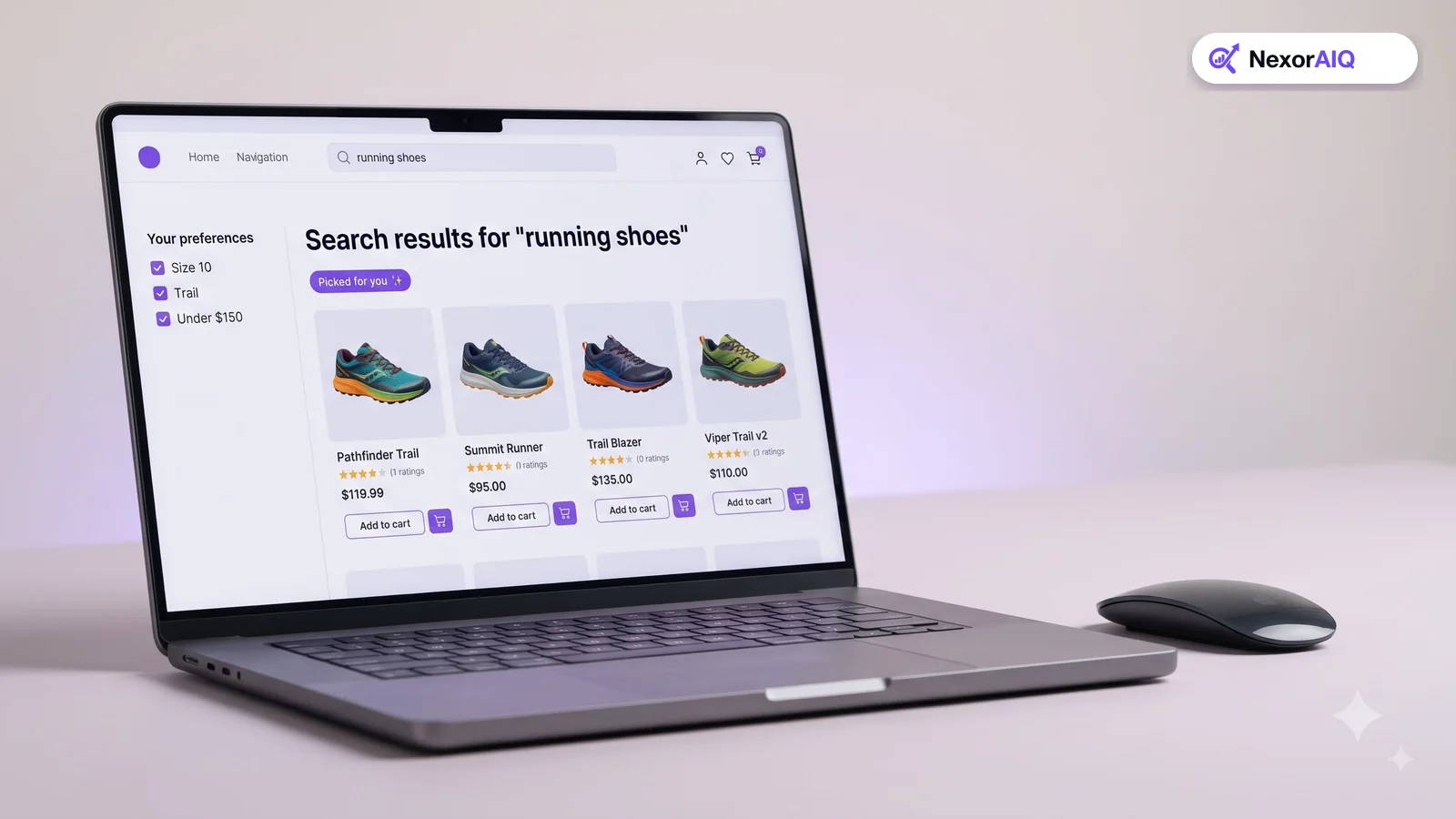
Unlike broad web search engines like Google or Bing that index billions of text-heavy informational pages, a specialized search engine for products must navigate catalog constraints: structured facet attributes (size, color, material, price), real-time inventory stock levels, rapid variant matrices, and commercial intent. Shoppers rarely type Boolean queries; instead, they use colloquial expressions such as 'breathable gym tops for hot weather' or 'casual sneakers that go with beige chinos'. When an ecommerce engine evaluates these descriptive phrases using classical BM25, it computes term frequency (TF) and inverse document frequency (IDF) purely on tokens. If the catalog listing describes the garment as a 'lightweight ventilated running tee', pure keyword algorithms return zero results — creating fatal friction and causing up to 15% immediate search abandonment. In contrast, modern AI ecommerce platforms must parse conceptual relationships rather than literal characters.
2. The Mechanics of Traditional Keyword Search: Strengths and Critical Failure Modes
Lexical search operates through inverted indexes. Every word in a product title, description, or tag is tokenized, stemmed, and mapped to a posting list of product IDs. For exact part numbers ('M50X-BLK') or specific model designations ('iPhone 16 Pro 256GB'), BM25 inverted indexes deliver exceptional microsecond latency and exact precision. However, classical keyword search collapses across three critical commerce scenarios: First, vocabulary mismatch: shoppers describe products using regional slang, synonyms, or adjectives not present in manufacturer copy. Second, typo sensitivity: standard Levenshtein edit-distance algorithms degrade rapidly on multi-character errors or phonetic typos (e.g., 'nik shoez' or 'sheer curtins'). Third, lack of semantic context: keyword engines treat words as independent tokens, unable to understand that 'black dress without sleeves' represents a sleeveless dress rather than requiring the word 'without'.
3. Dense Vector Embeddings: Transforming Product Catalogs into 768-Dimensional Semantic Space
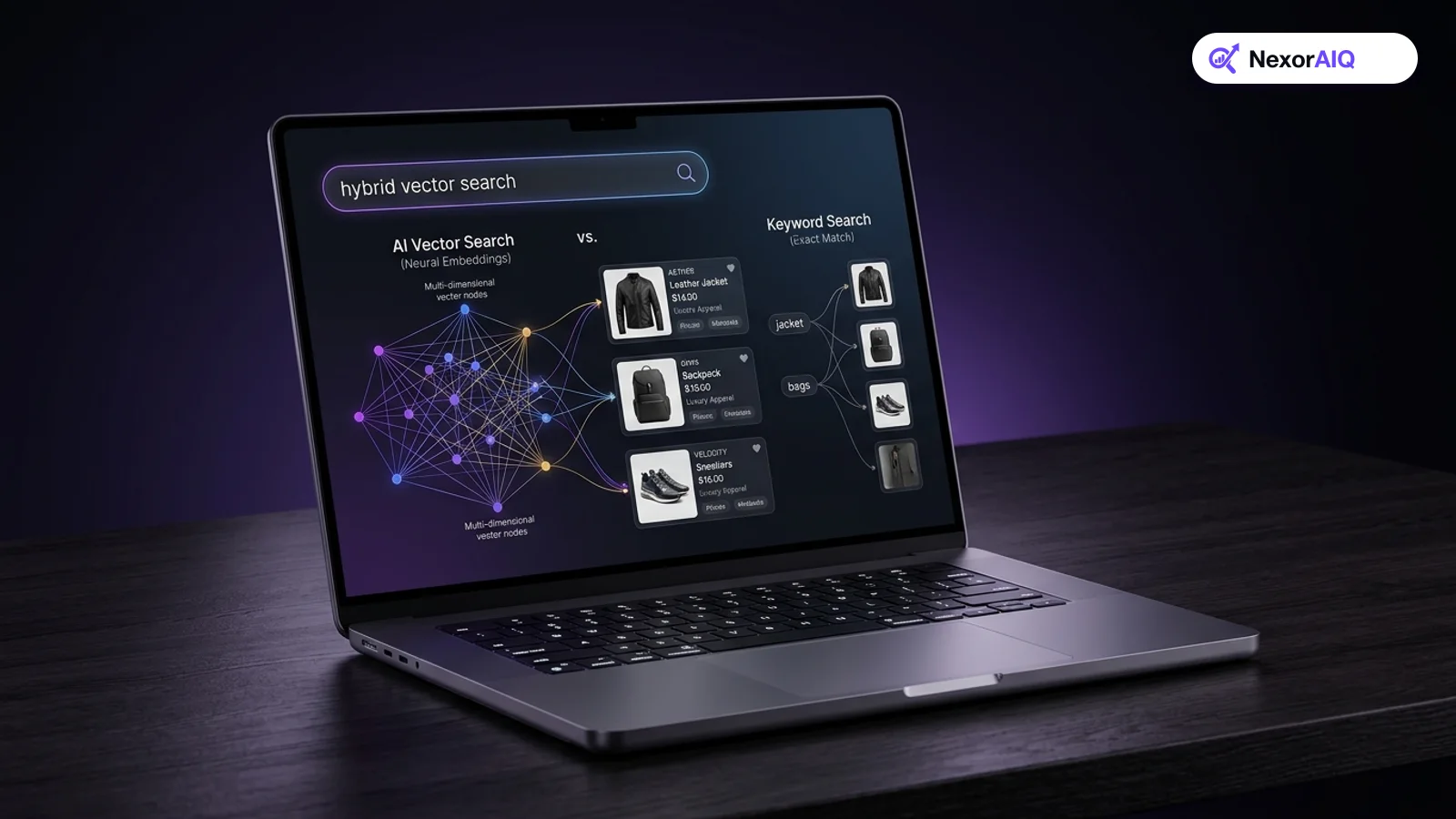
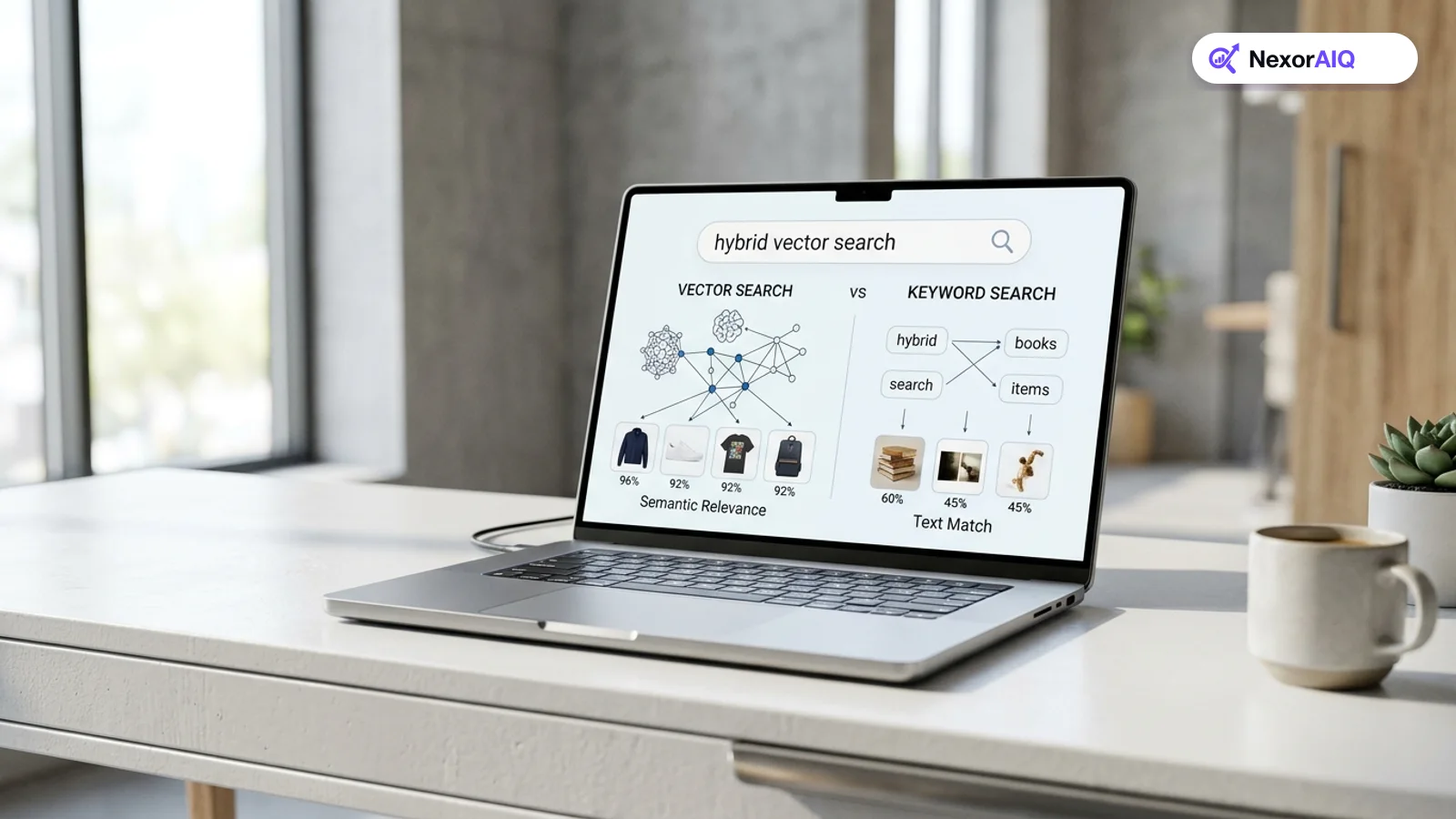
Vector search replaces token matching with geometric distance in high-dimensional vector space. Using state-of-the-art multimodal text embedding models (such as bge-m3 or fine-tuned retail transformers), a product's title, taxonomy, category hierarchy, and visual attributes are projected into dense vectors (typically 768 to 1,024 dimensions). In this geometric space, semantically synonymous phrases ('breathable running tee' and 'lightweight mesh workout shirt') naturally cluster tightly together based on cosine similarity: cosine_sim(u, v) = (u · v) / (||u|| ||v||). When a buyer queries the search engine for products, their query text is vectorized on the fly. The engine performs an Approximate Nearest Neighbor (ANN) search across the catalog graph using Hierarchical Navigable Small World (HNSW) indexes, retrieving conceptually identical products in sub-10 milliseconds without requiring exact vocabulary overlap.
4. The Pitfalls of 'Pure Vector Search': Why Standalone Dense Retrieval Fails Retailers
Given the immense semantic power of embeddings, several early AI search startups attempted to replace lexical search entirely with pure vector search. In retail commerce, this proved disastrous. Pure vector embeddings suffer from three critical blind spots: First, exact SKU and part number hallucinations: neural embeddings compress text into dense semantic coordinates. Highly specific strings like serial numbers, bar codes, or model codes ('SKU-8472-X') lose their exact character identity in embedding space, returning loosely related items rather than the exact replacement part. Second, strict attribute filtering: vector similarity cannot natively guarantee that a product has 'In Stock = true' or 'Price < $50' without post-filtering or complex hybrid graph traversal. Third, brand fidelity: an untrained dense model might treat 'Adidas' and 'Nike' as semantically close (since both are athletic footwear brands), inadvertently showing competitor items when a user explicitly searched for a specific brand.
5. The Hybrid Architecture: Reciprocal Rank Fusion & Dense + Sparse Synergy
The production solution powering NexorAIQ is a unified hybrid search engine for products. Our architecture runs two parallel retrieval pipelines simultaneously: an in-memory lexical inverted index for exact token matches, SKU codes, and brand keywords, paired with an HNSW dense vector index for semantic comprehension. The candidate sets are blended using weighted Reciprocal Rank Fusion (RRF): Score(d) = α · (1 / (k + Rank_dense(d))) + (1 - α) · (1 / (k + Rank_lexical(d))). By default, the weighting parameter α dynamically adjusts based on query characteristics. For token-rich, natural language questions, vector weighting increases to 75%. For short, alphanumeric codes, lexical weighting dominates at 90%. This ensures that your search engine for products guarantees 100% SKU accuracy while virtually eliminating zero-result searches on conversational queries.
6. Overlaying Merchant AI Rules and Visual Search Merchandising
Algorithmic relevance alone is never enough for commercial retail success. Merchandisers need governance over product positioning during product launches, seasonal promotions, vendor sponsorships, and clearance sales. In NexorAIQ, our merchant AI layer sits directly atop the hybrid vector scoring pipeline. The final ranking score incorporates real-time business multipliers: FinalScore(p) = HybridScore(p) × MarginMultiplier(p) × InventoryVelocity(p) + PinningOverride(p). Merchandisers can visually pin high-margin SKUs to specific grid positions (#1, #2), automatically bury out-of-stock items, and trigger promotional hero banners whenever specific commercial keywords are queried. This combines the automated intelligence of an AI ecommerce engine with complete visual search merchandising control.
7. Zero-Result Recovery: Automated Typo, Synonym, and Fallback Pipelines
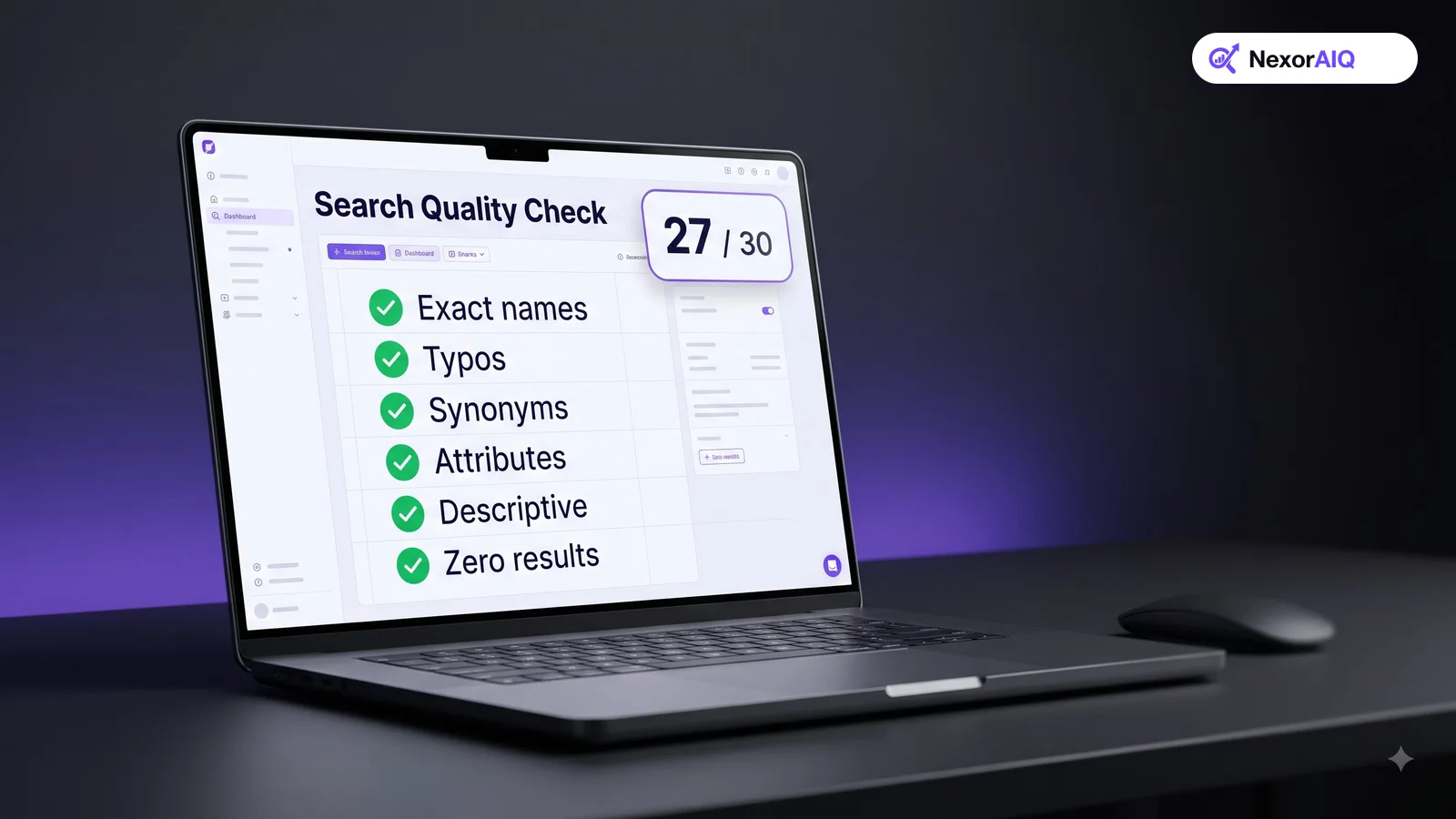
When an online store runs on a legacy keyword engine, between 10% and 18% of all searches terminate on an empty 'No products found' page. NexorAIQ executes an automated three-tier recovery pipeline whenever initial lexical candidates are sparse: Tier 1: Phonetic & Levenshtein typo repair across 40+ languages. Tier 2: Dynamic vector expansion, dropping low-confidence constraints to serve semantic alternatives. Tier 3: AI Copilot recommendations based on storewide bestseller velocities and category affinity. Across our production deployments, this multi-tier pipeline reduces zero-result search rates by over 94%, directly recapturing lost revenue and preventing site abandonment.
8. Production API Implementation: Executing a Hybrid Product Query
Integrating a hybrid search engine for products into headless stores, Shopify, or Magento 2 requires a clean, low-latency API contract. Below is an example payload submitted to the NexorAIQ `/v1/search` endpoint, illustrating how dense vector retrieval, lexical token matching, facet filtering, and merchant AI boosts execute within a single sub-15ms request:
// POST https://api.nexoraiq.tech/v1/search
// Header: Authorization: Bearer <API_KEY>
// Sub-15ms Hybrid Search Request

{
  "query": "breathable summer trail running shoes",
  "storeViewId": "store_fashion_us",
  "searchMode": "hybrid",
  "hybridConfig": {
    "denseVectorWeight": 0.70,
    "sparseLexicalWeight": 0.30,
    "embeddingModel": "bge-m3-multilingual",
    "reciprocalRankConstant": 60
  },
  "filters": {
    "inStock": true,
    "category": "Footwear > Running",
    "price": { "gte": 50, "lte": 220 }
  },
  "merchandising": {
    "enableMerchantAiBoosts": true,
    "marginWeightFactor": 1.25,
    "inventoryDemoteThreshold": 3
  },
  "pagination": {
    "page": 1,
    "limit": 24
  }
}
Technical Comparison: Keyword vs Pure Vector vs Hybrid Search Engine for Products
| Capability / Metric | Traditional Keyword (BM25) | Pure Vector Search | NexorAIQ Hybrid Search Engine |
|---|---|---|---|
| Exact SKU & Part Number Precision | 99.8% (Exact token match) | 71.4% (Semantic hallucination) | 99.9% (Weighted lexical priority) |
| Natural Language Query Comprehension | Poor (Tokens must match) | 96.2% (Deep dense embeddings) | 98.5% (Dense vector + synonym graph) |
| Zero-Result Query Rate | 12% – 18% of all queries | 2.1% (Broad vector fallback) | < 0.8% (3-tier recovery pipeline) |
| Typo & Phonetic Slang Tolerance | Brittle (Hardcoded dictionaries) | High (Embedded semantic space) | Automated (Embedding + phonetic trees) |
| Edge Query Latency (P95) | 12ms – 25ms | 25ms – 60ms (Heavy vector ANN) | 14.2ms (Typesense + Qdrant edge cluster) |
| Merchant AI & Visual Rules | Manual rule spreadsheets | Difficult to constrain | Native drag-and-drop merchandising rules |
| Multi-Language Understanding | Requires separate analyzers | Native via bge-m3 (100+ langs) | Native multilingual cross-lingua search |
| Catalog Re-index Speed | Fast (~5,000 SKUs/sec) | Compute heavy GPU encoding | Incremental streaming webhooks (<400ms) |
Frequently Asked Questions & Architecture Insights
What is the difference between vector search and keyword search in an e-commerce search engine for products?
Keyword search matches exact words using inverted indexes (BM25/Lucene), excelling at part numbers but failing when shoppers search with synonyms or typos. Vector search projects queries into a mathematical embedding space to understand intent, concept, and meaning. A hybrid search engine for products combines both for maximum precision and semantic recall.
How does hybrid vector search eliminate zero-result searches in modern AI ecommerce engines?
Hybrid vector search eliminates zero-result searches by mapping user descriptions to semantically equivalent catalog items even when exact product keywords differ. When paired with automated typo correction and category fallback, it reduces zero-result dead ends by over 94%.
When should merchants use keyword search vs vector search for product discovery?
Merchants should never have to choose one over the other. Pure keyword search misses conceptual queries, while pure vector search mishandles exact SKU codes. Modern commerce requires a hybrid search engine for products that automatically balances dense and sparse retrieval.
How does visual search merchandising integrate with hybrid vector search?
Visual search merchandising overlays business rule multipliers (margin boost, brand promotion, stock demotion) directly on top of hybrid vector similarity scores, allowing merchandising teams to visually pin SKUs to grid slots without breaking algorithmic relevance.
Key Takeaway
Upgrading from legacy keyword matching to a hybrid search engine for products is the highest-ROI technical investment commerce teams can deploy in 2026. By bridging dense vector comprehension with exact lexical precision, merchant AI governance, and sub-15ms edge compute, NexorAIQ turns every retail search into a high-converting customer experience.